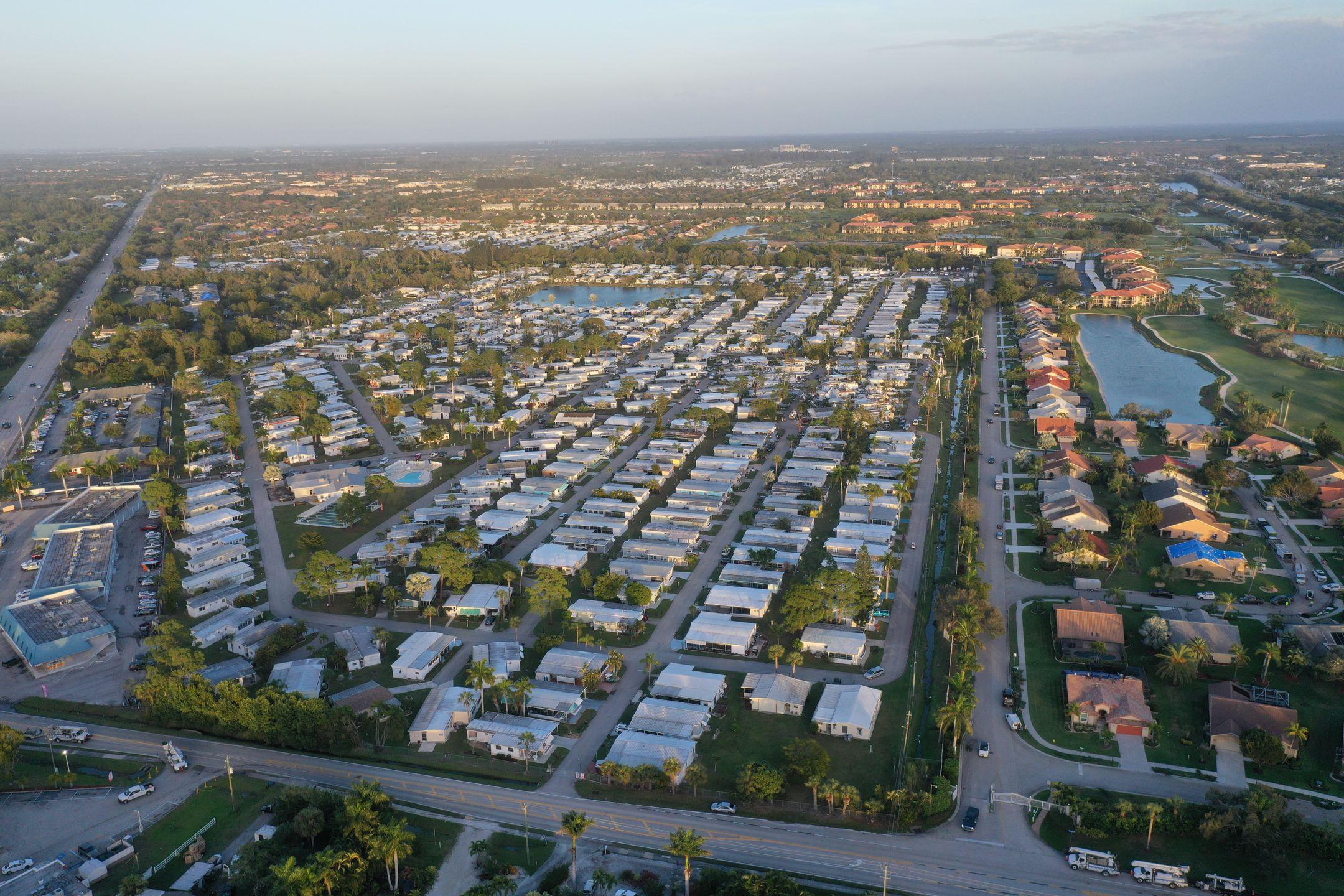
Ask most investors to name a commercial real estate asset class and you'll hear apartments, self-storage, maybe industrial. Almost nobody says mobile home parks — officially "manufactured housing communities," or MHCs — and that's exactly why the investors who do pay attention to them tend to do well out of it. It's one of the few corners of commercial real estate where big institutional capital has been circling for years without fully crowding out the smaller, hands-on buyer who's willing to learn a different operating model than a typical rental or apartment deal.
This guide covers how mobile home park investing actually works, why the economics run differently from most residential or multifamily deals, what it costs to get financed, the real risks nobody puts in the pitch deck, and where Winner Commercial fits in for Louisville and Southern Indiana investors looking at this niche.
Why sophisticated investors keep circling this asset class
The numbers explain the interest. As of early 2026, manufactured housing communities are trading at an average cap rate of roughly 5.9% nationally — down about 40 basis points from where they sat at the end of 2024, which tells you demand has kept climbing even as rates have moved. Compare that to roughly 5.5% for multifamily apartments and 5.5% for industrial, and MHCs are landing in a similar or slightly wider band — similar or better yield than apartments, with a very different risk profile.
The bigger number is turnover. Annual resident turnover in a mobile home park runs around 2.2%, versus roughly 47% for apartment buildings. That's not a typo. Once someone owns a manufactured home and has it set up on a pad — skirting, steps, a shed, a garden — moving it costs several thousand dollars and real hassle, so residents stay. Long average tenancy means fewer turns, fewer make-readies, and a more predictable income stream than almost any other residential-adjacent asset class.
Pricing varies a lot by class. Premium, 150+ lot communities with city utilities near major metros are trading in the 4.5–5.5% cap range. Stabilized 70–149 lot parks with decent infrastructure in suburban locations run 5.5–7.0%. Smaller, value-add parks with below-market rents or deferred maintenance can still be found at 7–10%+ — that's where most individual investors, as opposed to institutional buyers, are actually competing and winning deals.
The land-lease model: why this isn't landlording
The single biggest thing to understand before looking at a mobile home park deal is that in most parks, you are not in the business of owning and maintaining housing units. You're in the business of owning and maintaining land and infrastructure — the pads, the roads, the utility hookups, sometimes a clubhouse or laundry facility — and leasing that land by the lot to residents who own (or are financing) their own manufactured homes.
That's the land-lease or "tenant-owned-home" model, and it's the dominant structure for a reason: your capital expenditure exposure is dramatically lower than owning rental housing. You're not replacing water heaters, HVAC systems, or roofs on 60 individual homes — the residents are. Your job is keeping the land, roads, and utility systems functional, collecting lot rent, and managing who's allowed to move a home in or out.
The alternative structure is a park-owned-home (POH) community, where the park itself owns some or all of the homes and rents them out like a normal landlord would. POH deals can generate meaningfully higher revenue per lot, but they come with the maintenance burden, turnover costs, and capex exposure of owning housing stock — which is a very different operating business than a pure land-lease park. Most new investors are better served starting with a land-lease-dominant community and treating any park-owned homes as a smaller slice of the deal, not the core of it.
Utility billback: the most common value-add lever
One of the simplest ways operators add value to an underperforming park is converting water, sewer, and trash from a line item buried in rent into a separately billed charge — often called RUBS, ratio utility billing system. Instead of eating rising utility costs inside flat lot rent, the park bills residents their proportional share based on square footage, occupancy, or a submeter. Done correctly and disclosed properly, this alone can meaningfully improve net operating income on a park that's been under-managed for years, which is exactly the kind of value-add story lenders and buyers want to see when a deal trades.
How these deals actually get financed
Both Fannie Mae and Freddie Mac run dedicated manufactured housing community loan programs, and they're a major reason institutional capital has been comfortable scaling into this space. Fannie Mae's program, as a benchmark: up to 80% loan-to-value, minimum 1.25x debt service coverage, 5- to 30-year terms with amortization up to 30 years, and non-recourse financing with standard bad-act carve-outs. Eligibility has real teeth — a minimum of 50 pad sites, the community has to be rated Quality Level 3, 4, or 5, tenant-occupied (park-owned) homes generally can't exceed 35% of the community, and at least one key principal on the loan needs real MHC operating experience. Freddie Mac runs a comparable Optigo program, including a separate resident-owned-community product with its own minimums.
That agency financing is built for stabilized communities of real scale — it's not the tool for a 20-pad park that needs a repositioning. For smaller or rougher deals, the realistic financing path is a community or regional bank that already understands manufactured housing in your market, seller financing (common in this space precisely because institutional lenders pass on the smallest deals), or a bridge/hard-money structure to stabilize the asset before refinancing into an agency loan once it qualifies.
Supply is the real story: this inventory isn't coming back
Here's the structural fact that underpins almost every pitch for this asset class, and it holds in Kentucky and Southern Indiana as much as anywhere: most local jurisdictions stopped approving new manufactured housing community zoning decades ago. NIMBY opposition, density concerns, and a general political reluctance to approve new "trailer parks" (regardless of how dated that framing is) have made new MHC development exceptionally rare almost everywhere in the country. The parks that exist today are, in most markets, the parks that will exist in twenty years — nobody is building meaningful new competing supply next door. That supply lock-in is a big part of why institutional money has been willing to compress cap rates on stabilized parks, and why well-located existing parks tend to hold and grow value even through softer CRE cycles.
What can go wrong: the real risks
- Infrastructure age. Many parks run on decades-old septic systems, private wells, or aging water/sewer lines that were never built to modern code. A pre-purchase inspection of the actual infrastructure — not just a drive-through — is non-negotiable; a failed septic field or a collapsed sewer main can turn a good deal into a bad one fast.
- Collections and resident quality. Lot rent is usually modest relative to apartment rent, but it's still real income that has to be collected every month from a resident base that can skew lower-income. Underwrite realistic collections loss, not the seller's best-case trailing twelve.
- Regulatory and political risk. Kentucky has no statewide rent control, and that's unlikely to change soon — but some states have moved toward rent stabilization or resident right-of-first-refusal laws specifically targeting mobile home parks in response to private-equity roll-ups. It's worth tracking the political conversation even where it hasn't reached Kentucky or Indiana yet.
- Home-dependent occupancy. If a resident's home is old or in poor condition and they move out, re-filling that lot can mean financing or sourcing a replacement home yourself — which starts to look like the park-owned-home model's capex exposure, even in an otherwise land-lease-dominant park.
- Management is specialized. Park management isn't the same skill set as managing an apartment complex or a single-family rental portfolio. Self-managing without real MHC experience, or hiring a generalist property manager unfamiliar with the asset class, is one of the most common ways new park investors underperform their underwriting.
None of that makes mobile home parks a bad investment — it makes them a specialized one, which is exactly why the returns exist for investors willing to actually learn the operating model instead of assuming it works like a rental portfolio.
Where Winner Commercial fits in
Mobile home parks rarely trade on the open MLS, and a meaningful share of the best deals move through relationships and off-market conversations rather than public listings. That's the same sourcing muscle Winner Commercial already uses across Louisville commercial real estate — finding the deal before it's broadly marketed, running real underwriting on infrastructure and lot economics rather than taking a seller's pro forma at face value, and connecting buyers to the agency and local-bank financing paths that actually fit a given park's size and condition. See why investors work with Winner Realty for commercial and investment real estate for the full picture of how that process works, and check the current numbers on a prospective deal with our cap rate calculator before you get attached to a seller's asking price.
Frequently asked questions
Do I need special licensing to own a mobile home park?
No special real estate license is required to own one — it's treated as commercial real estate ownership like any other asset class. Depending on how hands-on you are with management, some states and localities require a business license to operate the park itself; check with local zoning and business-licensing offices before closing.
What's the minimum size park that qualifies for agency financing?
Fannie Mae's manufactured housing community program generally requires a minimum of 50 pad sites. Smaller parks typically need a community bank, seller financing, or bridge financing instead, often with a plan to refinance into agency debt once the park is stabilized and large enough to qualify.
What's the difference between a land-lease park and a park-owned-home community?
In a land-lease park, residents own or finance their own manufactured homes and pay you lot rent for the land and infrastructure — lower capex and maintenance burden for the owner. In a park-owned-home (POH) community, the park itself owns some or all of the homes and rents them out, which can mean higher revenue per lot but also the maintenance, turnover, and capital expense of owning housing stock, much closer to traditional landlording.
Is Kentucky a good market for this strategy?
Kentucky has no statewide rent control and, like most of the country, has approved very little new manufactured housing community zoning in recent decades — meaning existing parks in good locations are effectively irreplaceable supply. Winner Commercial can help you evaluate whether a specific park's location, infrastructure, and lot economics make sense before you commit capital.
If you're looking at a mobile home park deal in Kentucky or Southern Indiana, or want help finding one off-market, reach out to Rob and we'll walk through the underwriting together before you're staring down a closing date.