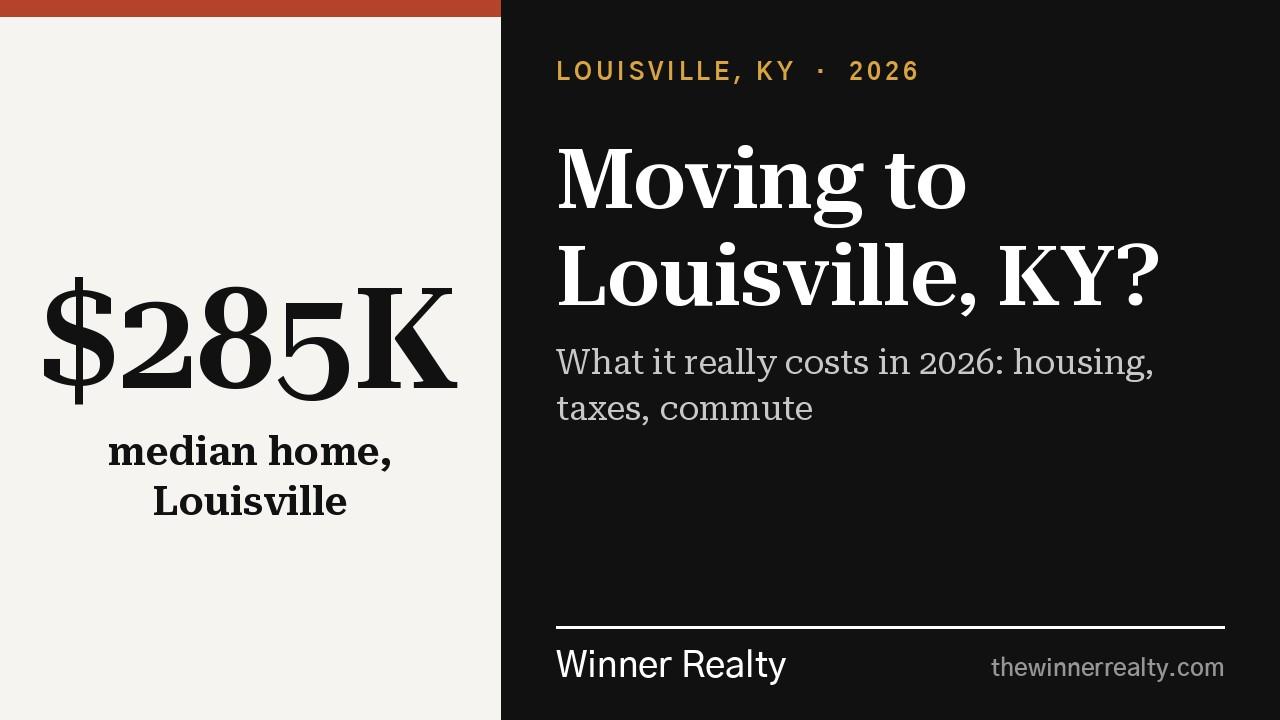
Thinking about moving to Louisville, Kentucky? This video goes through what it really costs in 2026: the house payment, Kentucky and Louisville taxes, Kentucky versus Southern Indiana, renting versus buying, and what the market looks like right now. The short version: the middle house here sold for $285,000 in September 2026, about $145,000 under the national median.
Numbers come from the Louisville MLS and the sources named in the video, as of October 24, 2026. Watch it here, or read the full script below.
Want Louisville homes in your budget sent to you, free? Set your buy box and matching homes come to you by email. Relocating? Start with the full written relocation guide and the 2026 cost of living breakdown.
The short answer
- Median home: $285,000 in September 2026, against about $430,000 nationally.
- Payment on the median home: about $1,860 a month in principal and interest at 5 percent down and 7.32 percent, about $2,300 with taxes and insurance.
- Income tax: Kentucky is a flat 3.5 percent in 2026. Louisville Metro adds a 2.2 percent occupational tax on wages.
- Property tax: about 1.14 percent, roughly $3,250 a year on the median home.
- Choice: 2,534 homes for sale, 32 percent more than a year ago.
Full script of the video
The real numbers
If you're thinking about moving to Louisville, Kentucky, here are the real numbers. The middle house here sold for $285,000 in September. The middle house in America sold for about $430,000. That gap, roughly $145,000, is the whole reason people keep moving here.
I'm Rob Bergeron. I own Winner Realty, and I've sold real estate in this city since 2013. Most of my out-of-state buyers show up with the same three questions. What does it actually cost? Where should I look? And is it really as good as people say? This is the video I wish every one of them had watched first. Louisville is a river city of about 1.4 million people in the metro area, the largest city in Kentucky, sitting right where Kentucky meets Southern Indiana.
The overall cost of living runs about 9 percent under the national average. Housing is about 26 percent under. Utilities, about 13 percent under. So the short answer to what does it cost is: less than you think. Let's go through it.
What housing costs
Start with the house payment. At today's 7.32 percent mortgage rate with 5 percent down, the Louisville median home runs about $1,860 a month in principal and interest. The national median at the same terms is closer to $2,800. Add taxes and insurance here and you're around $2,300 a month, all in, for the middle house in the city.
And there's selection. Right now there are 1,492 single-family homes for sale under $300,000 in Jefferson County alone. That's 59 percent of everything on the market. More than half of Louisville is still under $300,000.
So what does your budget buy? Around $250,000, you're looking at a solid three-bedroom ranch or a story-and-a-half in the south and southwest parts of the county, places like Okolona, Valley Station, Pleasure Ridge Park, and Fairdale. Older brick homes in parts of Shively. Or a condo in St. Matthews or the Highlands. Starter homes in Bullitt County land here too.
Around $400,000 opens up most of the established east-central neighborhoods. St. Matthews, Lyndon, Hikes Point, Bon Air, parts of Crescent Hill and Clifton. Updated homes in Jeffersontown, Middletown and Fern Creek, and a big share of the newer subdivisions out in the far east end.
$600,000 and up gets you the larger Highlands homes, Indian Hills, Glenview, Anchorage, Norton Commons, Prospect, Lake Forest, and most of Oldham County, where the median sale was around $450,000 this summer and the upper half runs well past that.
Taxes in Kentucky
Now taxes, because this is where transplants get surprised, in both directions. Kentucky's income tax is a flat 3.5 percent for 2026. It was 4 percent last year and 5 percent not long ago. On $100,000 of taxable income, that half-point drop alone is about $500 a year back in your pocket. Compared to Illinois at 4.95 percent, you'd pay about $1,450 a year less here.
The one nobody tells you about: if you live in Louisville Metro, there's an occupational license tax of 2.2 percent on wages. That's 1.25 for Metro, 0.75 for the school district, and 0.2 for transit. If you work in Louisville but live outside Jefferson County, it's 1.45 percent. Budget for it.
Sales tax is a flat 6 percent statewide, with no local add-ons. If you're coming from a place where the register total runs 9 or 10 percent, you'll notice that the first week.
Property taxes run about 1.14 percent of what the house is worth. On the $285,000 median home, that's about $3,250 a year, or $271 a month, rolled into your mortgage payment. Kentucky overall sits around 1.02 percent, so Louisville runs a touch above the state, and well under Texas, Illinois or New Jersey. Two more things. Kentucky charges an annual property tax on your vehicles when you renew the registration. And there's no annual safety or emissions inspection. If you're 65 or older, or disabled, the homestead exemption takes $49,100 off your assessed value.
Kentucky vs. Southern Indiana
Everyone here has heard that Indiana is cheaper. For a household that works in Louisville, the math is closer than the folklore. Indiana's state income tax is 2.95 percent, but every Indiana county adds its own: 2 percent in Clark County, that's Jeffersonville and Clarksville. 1.89 in Floyd County, New Albany and Floyds Knobs. 1 percent in Harrison County.
And if you live in Indiana and commute to a Louisville job, Louisville's 1.45 percent occupational tax still applies to those wages. The Kentucky-Indiana reciprocity agreement covers state income tax, not the city's. Indiana's sales tax is 7 percent versus Kentucky's 6.
Where Indiana does win clearly is property tax. The state constitution caps a homestead's property tax at 1 percent of assessed value. Winner Realty is licensed in both states, so we can run this comparison on your actual salary and your actual target house on both sides of the river. A Kentucky-only or Indiana-only agent simply can't do that.
Rent or buy
Should you rent first or buy? Renting a three-bedroom house runs about $1,500 a month right now. Owning the median home is about $2,300 with taxes and insurance. So renting is about $800 a month cheaper today, and there's nothing wrong with renting for six months while you learn the city.
If you'd rather buy, here's how buyers close that gap. One, a seller-paid rate buydown, which is back on the table because sellers have competition. Two, buy a two-unit, live in one side and rent the other. The median two-unit sold for $300,000 in September, and with the rent from the other side a lot of people live for less than $1,400 a month. Three, assume the seller's old low-rate loan where the loan allows it. And every 1 percent rates come down is about $180 a month on the median home. You can refinance the rate. You can't refinance the price you paid.
The market right now
Now, the market you're walking into. Louisville has 2,534 homes for sale, 32 percent more than a year ago and the most in over two years. Only 655 went under contract in September, down 26 percent from last year, because mortgage rates climbed back above 7.
That means 900 homes have now sat 60 days or more. More than a third of everything listed. The average home still goes under contract in about 28 days, but that average hides two different markets. The well-priced ones move. The rest sit, and sitting sellers negotiate. If you're relocating, this is the most choice buyers have had here since 2020.
Months of supply is at 2.9, the highest in a year. My rule for Louisville is about three and a half months means balanced. So sellers still have a slight upper hand, but barely, and it changes how you offer. A fall or winter move puts you in front of fewer competing buyers than spring.
Getting around
A few practical things. The typical commute is about 24 minutes. Louisville is a car city; plan on driving. The airport, Muhammad Ali International, now has a record 41 nonstop destinations, and it's also home to UPS Worldport, the biggest air-cargo hub in the world.
You're two and a half hours from Nashville, an hour and a half from Cincinnati, two from Indianapolis, four from St. Louis. Gas was about $2.82 in September. The tap water has won national taste awards, which sounds like a small thing until you've paid for bottled water in a city that needs it. And yes, the whole city stops for two weeks every spring for a two-minute horse race.
How to pick an area
How do you pick where to live? I'll tell you how I work with every client. I describe housing stock, price, commute, and what's physically there. I don't rank neighborhoods or characterize who lives in them, and neither should any agent you work with. That's both the law and the better way to choose. Drive your commute at 5:15 on a Tuesday. Look at the block in person. And look at the data yourself: Louisville Metro Police publishes crime data, and the school districts publish assignment information. I send those links for any address a client is considering, and I send the same links to everyone.
Two honest caveats. Summers are humid and the pollen is real. And the occupational tax plus the car tax are the two bills transplants didn't plan for. Everything else about the cost of living here tends to be a pleasant surprise.
Next step
If you are relocating to Louisville, the full written guide has every source, and it is free. If you want the list of homes under $300,000, or the tax comparison run on your actual numbers, tell us your budget and where you will be working and we will send what fits. Text us at (502) 305-8915 or email Rob at rob@thewinnerrealty.com.
Email me with any questions.
AI-narrated video. Equal Housing Opportunity. Winner Realty, Louisville, KY.